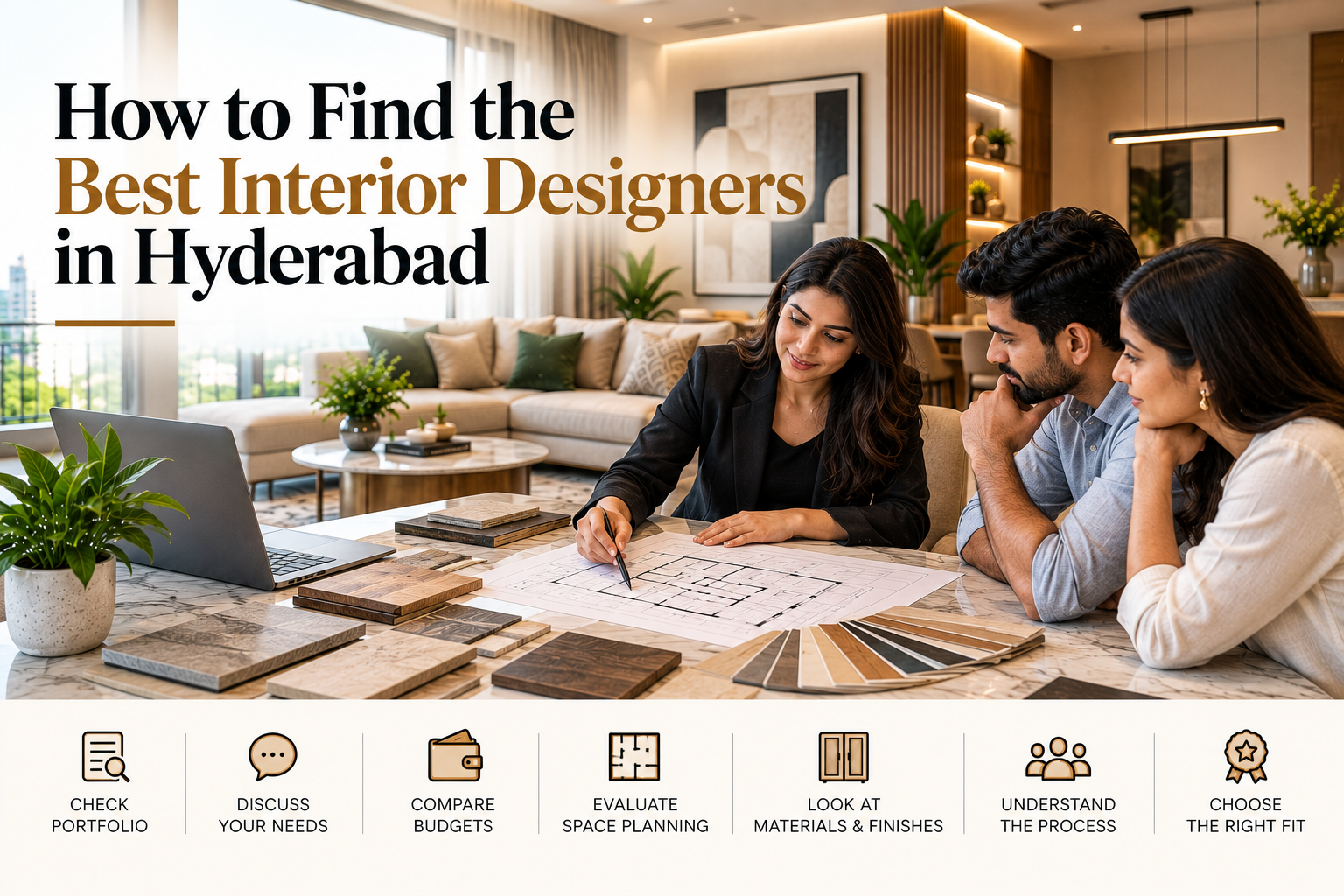
Choosing the right interior designer for your home is an important decision. Your choice can influence not only how your home looks, but also how comfortable, practical, organized, and enjoyable it is to live in for years to come.
With so many interior designers in Hyderabad, it can be difficult to know where to begin. A quick search can give you dozens of portfolios, advertisements, and attractive project photographs. But a beautiful photograph alone does not tell you whether a designer is the right fit for your home.
The right designer should understand your lifestyle, space, budget, preferences, and expectations—and turn those requirements into a practical design.
Here is a simple guide to help you choose the right interior designer in Hyderabad.
1. Start With Your Own Requirements
Before contacting designers, spend some time understanding what you actually need.
You do not have to know every technical detail. A simple list is enough.
Think about:
- The size and type of your home
- Number of bedrooms
- Kitchen requirements
- Storage needs
- Furniture requirements
- Home office needs
- Preferred design style
- Approximate budget
- Expected timeline
For example, you might want a modern living room, a highly functional modular kitchen, large wardrobes, and a dedicated work-from-home area.
Knowing these priorities will make conversations with designers much more productive.
2. Look at Their Portfolio
A designer’s portfolio is one of the first things you should review.
But don’t simply ask whether the projects look beautiful.
Look for projects that are similar to your own.
If you own an apartment, look for apartment projects. If you are planning a luxury villa, look for similar residential work.
Pay attention to:
- Layouts
- Furniture choices
- Storage solutions
- Material combinations
- Lighting
- Kitchens
- Bedrooms
- Overall finishing
A portfolio can give you an idea of the designer’s design language and whether it matches your expectations.
3. Check Whether They Understand Your Style
Every homeowner has different preferences.
Some people like minimal interiors. Others prefer warm luxury, contemporary designs, natural materials, or more decorative spaces.
The right designer should be able to understand your preferences instead of forcing you into a fixed style.
During your first discussion, share a few reference images and explain what you like about them.
A good designer should be able to identify the common elements in your references and adapt them to your home.
4. Ask About Their Design Process
A professional interior project should have a clear process.
Ask what happens after the initial consultation.
For example:
- Requirement discussion
- Space planning
- Concept development
- Material selection
- Design refinement
- Final detailing
- Execution
LUNORA Space Designs follows a structured process beginning with discovery and briefing, followed by concept and design, refinement, and execution.
Understanding the process before signing up can help you know what to expect at every stage.
5. Don’t Choose a Designer Based Only on Price
Budget is obviously important, but the cheapest quotation is not necessarily the best value.
Two designers may quote different amounts because their proposals include different:
- Materials
- Hardware
- Furniture
- Design services
- Customization
- Execution support
- Finishing details
Instead of asking only, “Who is cheaper?”, ask:
“What exactly am I getting for this price?”
Compare the scope of work carefully before making a decision.
6. Discuss Your Budget Honestly
You do not need to hide your budget from an interior designer.
In fact, sharing a realistic budget early can help the designer recommend appropriate materials, furniture, finishes, and solutions.
For example, you may have a fixed budget but want to create a premium-looking living room.
A designer can then help you decide where to invest more and where practical alternatives can be used.
A good interior project is not necessarily one where the most money is spent.
It is one where the available budget is used intelligently.
7. Evaluate Their Space-Planning Skills
A beautiful interior can still be uncomfortable if the layout is poorly planned.
Space planning is particularly important in Hyderabad apartments where every square foot may need to serve a purpose.
Ask how the designer approaches:
- Furniture placement
- Movement
- Storage
- Room proportions
- Functional zones
- Lighting
- Electrical points
LUNORA’s space-planning service focuses on layout studies, furniture size and placement, circulation, storage optimization, lighting positions, functional zones, and practical use of available space.
Good space planning can make a home feel more spacious without changing its actual size.
8. Ask About Storage
Storage is often underestimated during the initial design stage.
Think about what your family needs to store now—and what you may need to store in the future.
A good interior designer can integrate storage through:
- Full-height wardrobes
- Modular kitchen cabinets
- Built-in storage
- TV units
- Storage beds
- Custom cabinets
- Utility storage
The goal is to create enough storage without making the home feel visually crowded.
9. Look at Their Kitchen Designs
If you are designing a complete home, pay particular attention to the designer’s kitchen projects.
The kitchen needs to balance appearance and functionality.
Ask whether the designer considers:
- Cooking habits
- Appliance placement
- Counter space
- Cabinet organization
- Pantry requirements
- Corner storage
- Lighting
- Ease of movement
LUNORA’s modular kitchen service covers layout planning, cabinet and drawer design, countertop guidance, appliance placement, backsplash and colour selection, lighting suggestions, and storage optimization.
A kitchen should be designed around the person using it—not just around how it looks in a photograph.
10. Understand Their Approach to Custom Furniture
Standard furniture can work perfectly well in many homes. However, some spaces require customized solutions.
Custom furniture can be particularly useful for:
- Wardrobes
- TV units
- Study desks
- Storage cabinets
- Display units
- Beds
- Built-in seating
Ask the designer when customization is actually necessary.
You do not need to customize everything.
The best approach is to use custom furniture where it solves a specific space, storage, or functionality problem.
LUNORA’s custom furniture service includes size and layout customization, material and finish selection, storage integration, comfort planning, and matching furniture with the overall interior theme.
11. Ask About Materials and Finishes
Materials can significantly affect both the appearance and longevity of your interiors.
Ask your designer about the materials being recommended for:
- Kitchen cabinets
- Wardrobes
- Countertops
- Wall panels
- Furniture
- Flooring
- Hardware
- Lighting
Don’t hesitate to ask why a particular material is being recommended.
You should understand its:
- Durability
- Maintenance
- Appearance
- Cost
- Suitability for the room
The right material is not always the most expensive material.
12. Check How They Handle Communication
Interior design is a collaborative process.
You will probably need to approve layouts, materials, finishes, furniture, colours, and other details along the way.
Therefore, communication matters.
Before hiring a designer, understand:
- Who will be your main point of contact?
- How often will updates be provided?
- How are design changes handled?
- How are approvals taken?
- How are concerns addressed?
A designer who communicates clearly can make the overall experience much smoother.
13. Ask About Execution Support
Design and execution are closely connected.
A beautiful design needs to be implemented correctly for the final result to match the concept.
Ask whether the designer provides execution guidance or coordination and understand exactly what that involves.
You should know:
- Who coordinates vendors?
- Who checks measurements?
- Who handles material selection?
- Who monitors finishing?
- Who resolves execution-related issues?
Clarifying these responsibilities early can prevent confusion later.
14. Consider Long-Term Functionality
Your home should not only look good when the project is completed.
It should continue to work for you years later.
Ask yourself:
- Will there be enough storage?
- Are the materials easy to maintain?
- Is the furniture comfortable?
- Can the space adapt to changing needs?
- Is the kitchen practical?
- Is the lighting suitable for everyday use?
A professional designer should think beyond the final photographs and consider how you will actually live in the space.
15. Meet the Designer Before Making a Decision
If possible, have a proper consultation before finalizing your interior designer.
Use the meeting to explain your requirements and ask questions.
Pay attention to how the designer responds.
Do they listen?
Do they ask questions about your lifestyle?
Do they understand your budget?
Do they explain their recommendations?
Do they try to understand your priorities?
These interactions can tell you a lot more than a portfolio alone.
Red Flags to Watch Out For
While searching for interior designers in Hyderabad, be cautious if:
- The quotation is unclear.
- The scope of work is not documented.
- The designer refuses to discuss materials.
- Everything is presented as an additional cost.
- There is no clear design process.
- Communication is difficult from the beginning.
- You are pressured to make a quick decision.
- The designer focuses only on aesthetics and ignores functionality.
A professional relationship should feel transparent from the beginning.
What Makes a Good Interior Designer?
The best interior designer is not necessarily the one with the most expensive portfolio.
A good designer should be able to balance:
Aesthetics + Functionality + Space Planning + Budget + Materials + Personalization
They should understand that your home is not a showroom.
It is where you wake up, cook, work, relax, spend time with family, entertain guests, and create memories.
That is why the design needs to work in real life.
Why LUNORA Space Designs?
LUNORA Space Designs is a luxury interior design studio in Hyderabad focused on combining modern aesthetics, premium craftsmanship, thoughtful functionality, and timeless design.
The studio offers:
- Residential Interiors
- Commercial Spaces
- Modular Kitchens
- Space Planning
- Custom Furniture
Its residential interior service includes complete home interior planning, room-wise layouts, furniture placement, colour and material selection, lighting concepts, modular storage, custom furniture suggestions, premium finish recommendations, and execution guidance.
The approach is centered around understanding the client and creating interiors around their lifestyle rather than relying on a standard template.
Final Thoughts
Finding the best interior designers in Hyderabad is not simply about finding the designer with the most impressive photographs or the lowest quotation.
It is about finding someone who understands your space, listens to your requirements, respects your budget, communicates clearly, and can turn your ideas into a practical design.
Take your time. Compare portfolios, understand the scope, ask questions, discuss materials, and make sure you are comfortable with the design process before committing.
The right interior designer should do more than make your home look beautiful.
They should help you create a home that feels right for the way you live.
Leave a Reply