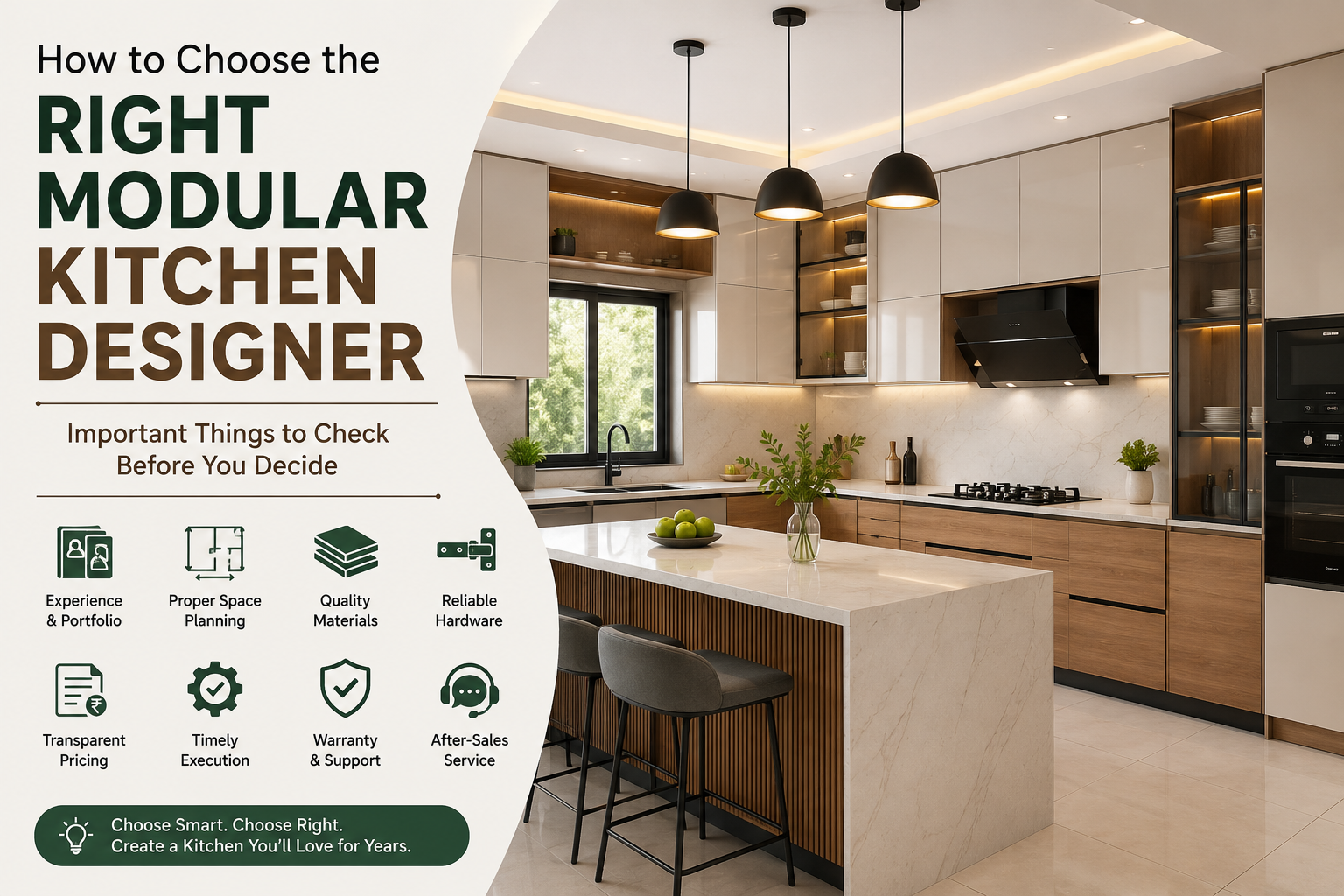
A modular kitchen can completely change the way your home looks and functions. It can give you better storage, smoother movement, a cleaner appearance, and a more organized cooking space. However, choosing the right modular kitchen designer matters just as much as choosing the design itself.
With so many designers and interior companies offering modular kitchens, homeowners often find it difficult to know whom they can trust. A beautiful 3D design may look impressive, but the real test begins when the team starts measuring, manufacturing, installing, and finishing your kitchen.
So, before you finalize a modular kitchen designer, take a little time to evaluate their experience, materials, design process, pricing, and after-sales support. Here are the most important things you should check.
1. Check Their Experience and Portfolio
First, look at the designer’s previous work.
A portfolio gives you a better idea of the designer’s style, attention to detail, and ability to handle different kitchen layouts. Don’t look only at highly edited photographs. Instead, ask to see completed projects and, if possible, photographs taken after installation.
Look for kitchens similar to your own requirements, such as:
- Compact apartment kitchens
- L-shaped kitchens
- U-shaped kitchens
- Parallel kitchens
- Island kitchens
- Open kitchens
- Luxury modular kitchens
Most importantly, check whether their previous designs balance appearance and functionality. A kitchen should look beautiful, but it should also make everyday cooking easier.
2. Understand Your Kitchen Requirements First
Before meeting a designer, think about how you actually use your kitchen.
For example, consider:
- How many people regularly cook at home?
- How much storage do you need?
- Do you use large appliances?
- Do you need space for a microwave or built-in oven?
- Do you prefer open shelves or closed cabinets?
- Do you need a dedicated pantry?
- How much countertop space do you want?
- Do you prefer a modern, minimal, or traditional look?
Once you understand your requirements, you can communicate them more clearly to the designer.
Furthermore, a good designer should ask questions about your lifestyle instead of simply showing you a standard catalogue.
3. Check Whether They Offer Proper Space Planning
A good modular kitchen starts with proper planning.
The designer should carefully measure the kitchen and consider the position of doors, windows, plumbing, electrical points, gas connections, appliances, and ventilation.
Then, they should plan the work zones and make movement comfortable.
For instance, the placement of the:
- Refrigerator
- Sink
- Hob
- Prep area
- Storage cabinets
should work together logically.
A beautiful kitchen can quickly become frustrating if you have to walk across the room repeatedly while preparing a meal.
Therefore, don’t finalize a designer based only on colours and finishes. Ask how they plan the space.
4. Ask About the Materials They Use
Material quality directly affects the durability of your kitchen.
Before you sign the agreement, ask the designer exactly what materials they propose for:
- Cabinet carcasses
- Shutters
- Shelves
- Back panels
- Countertops
- Handles
- Hardware
- Edge bands
Depending on your budget and requirements, designers may recommend options such as plywood, MDF, HDHMR, or other engineered boards.
However, don’t simply ask, “Which material is best?”
Instead, ask:
“Which material are you recommending for my kitchen, and why?”
A reliable designer should explain the advantages, limitations, maintenance requirements, and expected durability of each option.
5. Pay Attention to Hardware Quality
Cabinet boards get most of the attention, but hardware plays an equally important role in everyday use.
Drawers and shutters open and close hundreds or even thousands of times over the years. Therefore, good hinges, drawer channels, lift-up systems, baskets, and other fittings can make a noticeable difference.
Ask about:
- Hinges
- Drawer channels
- Tandem drawers
- Corner units
- Tall-unit mechanisms
- Lift-up systems
- Bottle pull-outs
- Soft-close mechanisms
Also, ask whether the quotation clearly mentions the hardware specifications.
A quotation that simply says “premium hardware” doesn’t tell you much. You should know exactly what you’re paying for.
6. Compare Quotations Carefully
Price matters, but the cheapest quotation isn’t necessarily the best deal.
When you compare two modular kitchen quotations, check whether both companies have included the same things.
For example, one quotation may include:
- Cabinets
- Hardware
- Installation
- Countertop
- Baskets
- Lighting
- Delivery
while another may exclude several of these items.
As a result, a cheaper quotation can eventually become more expensive.
So, ask for a detailed quotation that clearly separates:
Materials + Hardware + Accessories + Installation + Other Charges
This makes comparison much easier.
7. Check What the Package Includes
Before finalizing your modular kitchen designer, ask exactly what the package covers.
For example:
Does the quotation include installation?
Does it include transportation?
Is countertop work included?
Are electrical modifications included?
Does it include plumbing changes?
Are kitchen accessories included?
Does it include dismantling an existing kitchen?
Are taxes included?
Is installation covered under warranty?
These questions may seem small initially. However, they can prevent unexpected expenses later.
8. Review the Design in Detail
Never approve a kitchen design after looking at only one attractive 3D image.
Ask the designer to explain the complete layout.
You should understand:
- Cabinet dimensions
- Storage locations
- Appliance positions
- Countertop height
- Drawer sizes
- Overhead storage
- Corner storage
- Tall units
- Lighting
- Electrical points
Also, walk through the design mentally.
Imagine yourself preparing breakfast, washing vegetables, storing groceries, using appliances, and cleaning the countertop.
Does the layout feel comfortable?
If something feels inconvenient in the design stage, it will probably feel even more inconvenient after installation.
9. Ask About Customization Options
Every kitchen has different dimensions and requirements. Therefore, a good modular kitchen designer should offer more than a fixed catalogue of standard designs.
Ask whether they can customize:
- Cabinet dimensions
- Storage units
- Finishes
- Colours
- Handles
- Shelves
- Drawers
- Appliance units
- Corner solutions
For example, an apartment kitchen may have an unusual wall, beam, column, or window position. A thoughtful designer should work around these limitations rather than forcing a standard layout into the space.
10. Check the Installation Process
Even a well-designed kitchen can look poor if the installation team doesn’t pay attention to detail.
Before finalizing the designer, ask:
- Who handles installation?
- Is the installation team experienced?
- How long will installation take?
- Who coordinates electrical and plumbing work?
- How do they handle corrections?
- Who will inspect the final installation?
Furthermore, ask whether the designer provides a dedicated project manager.
Having one person coordinate the project can make communication much easier.
11. Understand the Timeline
Kitchen projects involve several stages, including:
Measurement → Design → Material Selection → Manufacturing → Delivery → Installation → Finishing
Therefore, ask for an estimated timeline before you finalize the project.
However, don’t accept unrealistic promises simply because they sound attractive.
Instead, ask the designer to explain:
- Design approval time
- Manufacturing time
- Delivery schedule
- Installation duration
- Final inspection
A clear timeline helps you plan your home renovation without unnecessary stress.
12. Check the Warranty and After-Sales Support
A modular kitchen represents a significant investment. Consequently, you should know what happens if something goes wrong after installation.
Ask about warranties for:
- Cabinets
- Hardware
- Accessories
- Finishes
- Manufacturing defects
Also, find out how the company handles service requests.
A designer who provides clear after-sales support gives you greater confidence in the long-term value of your investment.
13. Read Reviews, But Look Beyond the Rating
Online reviews can help you understand how a designer works with customers.
However, don’t look only at the star rating.
Read what customers actually say about:
- Design quality
- Communication
- Installation
- Timelines
- Material quality
- Budget management
- Problem resolution
- After-sales service
If you notice repeated complaints about delays or poor communication, take them seriously.
At the same time, remember that reviews represent individual experiences. Therefore, consider the overall pattern rather than relying on one review.
14. Evaluate Communication
Good communication can make your interior project much smoother.
From the first consultation, notice whether the designer:
- Listens to your requirements
- Explains options clearly
- Answers questions patiently
- Shares realistic timelines
- Provides transparent pricing
- Responds consistently
A designer who communicates well during the initial consultation will usually make the rest of the project easier to manage.
15. Don’t Ignore the Finish and Maintenance
Your kitchen should look good not only on installation day but also after years of regular use.
Therefore, ask about maintenance requirements for your chosen finishes.
For example:
- Is the finish easy to clean?
- Does it show fingerprints easily?
- How does it handle moisture?
- Is it suitable for heavy cooking?
- How easily can damaged components be replaced?
These questions become particularly important for Indian kitchens, where frequent cooking, heat, steam, oil, and moisture can affect surfaces.
Questions to Ask Before Hiring a Modular Kitchen Designer
Before signing the final agreement, keep this checklist handy:
Design
- Will you provide a detailed 3D design?
- How many design revisions are included?
- Will you customize the layout according to my requirements?
Materials
- What material will you use for the cabinets?
- What finish will you recommend?
- Which hardware brands or specifications are included?
Pricing
- Is the quotation itemized?
- Are installation and transportation included?
- Are taxes included?
- What additional costs could arise?
Execution
- Who will manufacture the kitchen?
- Who will install it?
- How long will installation take?
- Who coordinates electrical and plumbing work?
Warranty
- What is covered under warranty?
- How long does the warranty last?
- How do I request after-sales service?
Getting clear answers to these questions can help you avoid unpleasant surprises later.
How to Choose the Right Modular Kitchen Designer in Hyderabad
If you’re searching for a modular kitchen designer in Hyderabad, don’t choose a company based only on the lowest quotation or the most attractive 3D rendering.
Instead, consider the complete package:
Design expertise + Material quality + Space planning + Hardware + Transparent pricing + Installation + Warranty + Customer support
Hyderabad homes also come in many different formats, from compact apartments in growing residential communities to spacious villas and premium residences. Therefore, your designer should understand how to adapt the kitchen to your available space and lifestyle.
For a premium home, you may also want to consider how the kitchen connects visually with the living and dining areas. A consistent palette, thoughtful lighting, coordinated storage, and custom furniture can make the entire home feel more cohesive.
Why the Right Designer Makes a Difference
A modular kitchen isn’t simply a collection of cabinets. It becomes one of the most frequently used spaces in your home.
That’s why the right designer looks beyond appearance.
They study your space, understand your routine, plan storage carefully, recommend suitable materials, and coordinate the installation. As a result, you get a kitchen that feels beautiful while also working effortlessly every day.
At LUNORA Space Designs, our approach combines thoughtful space planning, modern layouts, premium finishes, smart storage, and customized solutions. We design modular kitchens around the way each client lives and uses their home rather than relying on one-size-fits-all designs.
Final Thoughts
Choosing a modular kitchen designer deserves careful consideration. After all, your decision affects the design, functionality, durability, budget, and overall experience of your project.
So, before you finalize a designer, check their portfolio, understand the materials, compare detailed quotations, evaluate the layout, ask about installation and warranty, and pay close attention to communication.
Most importantly, choose a designer who listens to what you need and can turn those requirements into a kitchen that works beautifully for everyday life.
A well-planned modular kitchen isn’t just attractive. It makes cooking, organizing, cleaning, and living at home easier—and that’s what good interior design should ultimately achieve.